
The sound becomes sign
Le Temple-sur -Lot, 5 August 2022
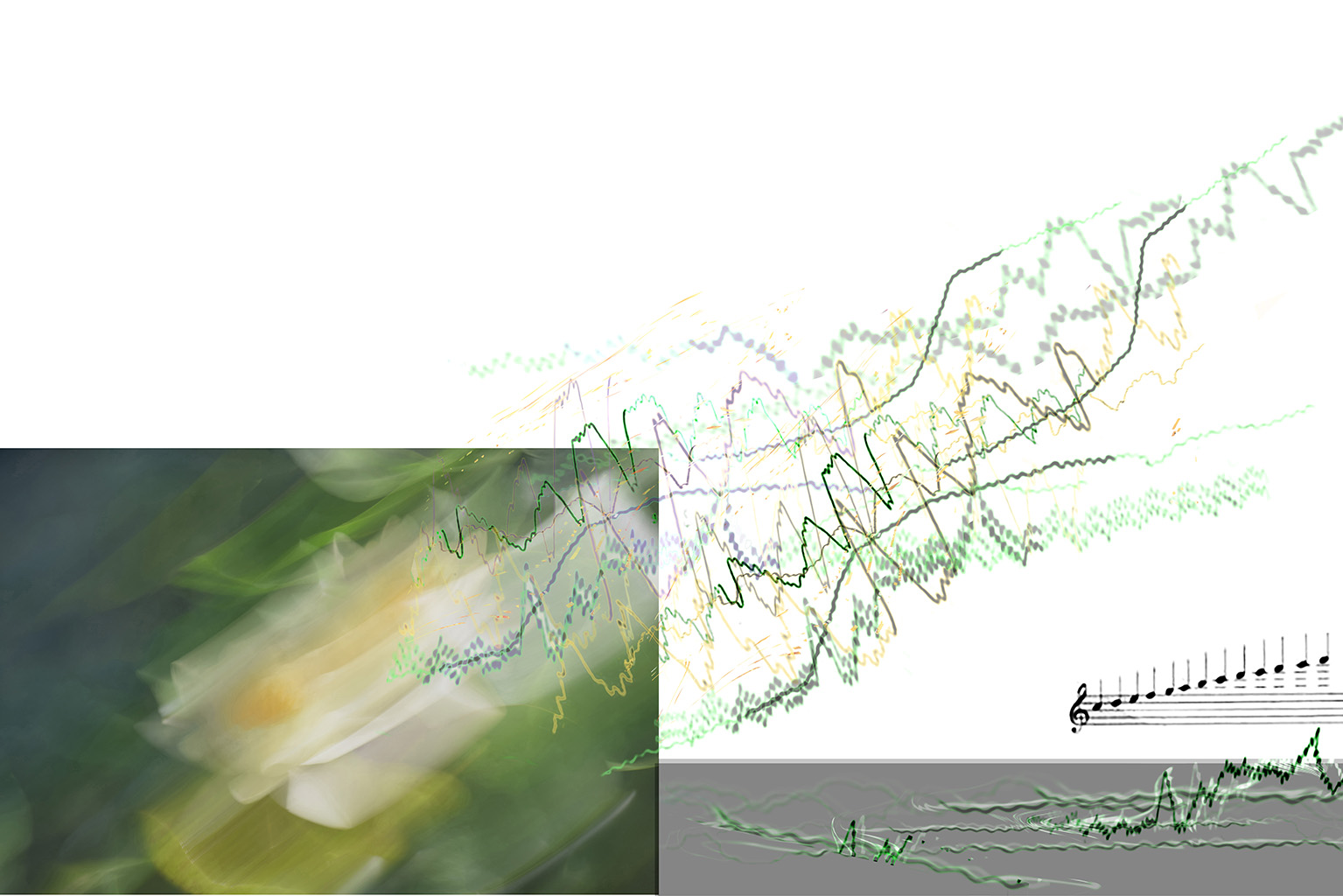
Sounds. They seemed to come from the central body of the flowers; they expanded sharp, bright and small, a little jagged. They seemed to go into space, with an ascending rhythm. Some groups of coloured lines, not brazen or too present, were superimposed, clear, clean. The energy was evenly distributed over the whole spectrum of vibrations produced. Every now and then the sounds were interrupted by something that fragmented them: a metallic, extraneous and distant noise that in the auditory landscape interrupted the regularity of perception. In the presence of wind they reached higher peaks, in correspondence with the cooler gusts, and then fell back towards a lower and more opaque rhythmic repetition until the next gust.
The uniformity of the signals was separated by almost imperceptible intervals. They were represented graphically in my mind as groups of strokes or repeated lines, expanding in size as the haze descended.
Tones came out of the pond that were a little dull, muted, as if veiled and with fewer peaks. More linear, but not heavy. I did not perceive the sounds with the auricle, but with the inner ear, which was, however, linked to the visual datum of the colours present in the scene and to the tactile datum, in the body of the air.
///
Suoni. Sembravano provenire dal corpo centrale dei fiori; si espandevano acuti, luminosi e piccoli, un po’ frastagliati. Parevano andare nello spazio, con un ritmo ascendente. Alcuni gruppi di linee colorate, non sfacciate o di troppa presenza si sovrapponevano, chiare, pulite. L’energia era ben distribuita su tutto lo spettro delle vibrazioni prodotte. Ogni tanto i suo- ni erano interrotti da qualcosa che li frammentava: un rumore metallico, estraneo e lontano che nel panorama uditivo interrompeva la regolarità della percezione. In presenza di vento raggiungevano picchi più alti, in corrispondenza delle folate più fresche, per poi ripiegare verso una ripeti- zione ritmica più bassa e opacizzata fino alla folata successiva.
L’uniformità dei segnali era separata da intervalli quasi impercettibili. Si rappresentavano graficamente nella mia mente come gruppi di tratti o di linee ripetute, in espansione dimensionale man mano che scendeva la foschia.
Dalla vasca uscivano toni un po’ sordi, smorzati, come velati e con meno picchi. Più lineari, ma non grevi. I suoni non li avvertivo con il padiglione auricolare, ma con l’orecchio interiore che però si agganciava al dato visivo delle cromie presenti nella scena e al dato tattile, nella corposità dell’aria.
///
Des sons. Ils semblaient provenir du corps central des fleurs ; s’épanouissaient, aigus, petits et lumineux, un peu dentelés. Ils paraissaient aller dans l’espace, portés par un rythme ascendant. Quelques groupes de lignes colorées, ni insolentes ni trop voyantes, se superposaient, claires, nettes. L’énergie était bien répartie sur tout le spectre des vibrations produites. Par moments, les sons étaient interrompus par quelque chose qui les fragmentait : un bruit métallique, étranger et lointain qui, dans le paysage auditif, rompait la régularité de la perception. En présence de vent, ils atteignaient des sommets plus élevés, suivant les rafales les plus fraîches, avant de se replier dans une répétition rythmique plus basse et feutrée, jusqu’à la bourrasque suivante.
L’uniformité des signaux était entrecoupée d’intervalles presque imperceptibles qui se présentaient graphiquement dans mon esprit comme des ensembles de traits ou de lignes répétées, s’élargissant à mesure que descendait la brume.
Du bassin s’élevaient des tonalités un peu sourdes, étouffées, comme voilées, et aux reliefs moins marqués. Plus linéaires, mais sans poids. Je percevais ces sons non pas avec le pavillon de l’oreille, mais avec mon oreille interne, qui s’accrochait toutefois à l’élément visuel des couleurs de la scène et à l’élément tactile, dans la densité de l’air.